






What income do you use to figure out your tax bracket?
You’ll use your “taxable income” to find your tax bracket. This can be much lower than your gross income.
The difference?
- Your gross income is all the money you make in a year
- Your taxable income is what’s left after taking out your business expenses and subtracting all the other tax deductions you’re entitled to
Here’s how to calculate your taxable income.
Step #1: Subtract what it costs to run your business or side hustle
Before you even get to the standard deduction, freelancers get to subtract business deductions from their self-employment income. The result is your “net self-employment income.”
For example, if your gross income from 1099 work is $35,000, but you spent $5,000 on work-related expenses throughout the year, your net self-employment income would be $30,000.
Everyone who works for themselves, even a little, gets to take out the cost of doing that self-employed work. This is true whether you’re a solopreneur making millions, a side hustler taking on weekend projects, or a full-time gig worker.
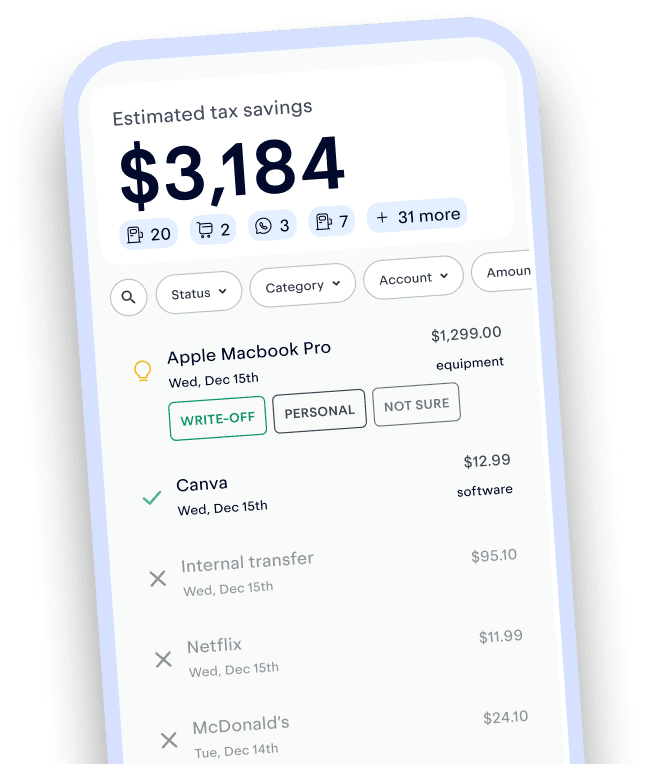
Not sure what kind of deductions you qualify for? The Keeper app will find them for you automatically based on the kind of 1099 work you do. That way, you never miss an opportunity to save!
{upsell_block}
Step #2: Find your adjusted gross income
After you’ve taken out your business deductions, you’ll need to combine your net self-employment income with anything you earned from W-2 jobs. You’ll use this number when you calculate your adjusted gross income (AGI).
Your adjusted gross income is what’s left after you take out what’s called “above-the-line” deductions. These are available to you even if you claim the standard deduction (which is a “below-the-line” deduction).
Above-the-line deductions are found on Part II Form 1040, Schedule 1. They include:
- Contributions to a health savings account (HSA), line 13
- Half of your self-employment tax, line 15
- Contributions to some retirement plans, like a SEP or SIMPLE, line 16
- What you pay for self-employment health insurance, line 17
- Some of the student loan interest you pay, line 21
- Some of the alimony you pay, if you got divorced before 2019, line 19a

Step #3: Take out your below-the-line deductions
Your below-the-line deductions are either the standard deduction or your itemized personal deductions.
For the 2023 tax year, the standard deductions were:
- $13,850 for single filers
- $27,700 for married filers
- $20,800 for heads of household
For the 2024 tax year, the standard deductions were:
- $14,600 for single filers
- $29,200 for married filers
- $21,900 for heads of household
For the 2025 year, the standard deductions are:
- $15,750 for single filers
- $31,500 for married filers
- $23,625 for heads of household
{write_off_block}
Finding the tax bracket for your filing status
Once you’ve calculated your taxable income, you can then use that number to find your tax bracket.
2025 tax brackets
The tax brackets for the 2025 tax year (for which you file in early 2026) are as follows:
Just because your taxable income lands in a particular bracket, that doesn’t mean you’ll pay that much tax on all of your taxable income.
Your bracket represents your marginal tax rate. What you actually pay is your effective tax rate.
Marginal vs. effective tax rates: What’s the difference?
Your marginal tax rate is the highest tax rate you pay, while your effective tax rate is the overall percentage of your income going toward taxes. You can quickly find your effective tax rate using our free self-employment tax rate calculator.
The US has a progressive income tax system. What this means is that your income is taxed at different rates. You only pay the marginal rate on the amount of income that falls within that tax bracket.
How to find your effective tax rate
For example, if you make $50,000 in taxable income, you’ll be in the 22% marginal tax bracket. But your effective tax rate is only 11%.
Here’s how your $50,000 is actually getting taxed. You’ll pay:
- 10% on the first $11,925 ($11,925 x 10% = $1,192.50)
- 12% on the next $36,650 of your income ($48,475 - $11,925) x 12% = $4,386
- 22% on the final $1,525 of your taxable income ($1,525 x 22% = $335.50)
In the end, you’d only pay about $5,914 in federal income taxes on your $50,000 of taxable income — about 12%. That’s about half of the 22% marginal rate for your income level.
How do self-employment taxes fit in?
Aside from your income taxes, self-employed people need to deal with self-employment taxes.
When you work for someone else as an employee, your employer will cover half of your Social Security and Medicare tax payments, which are often referred to as the “payroll tax.” However, you’re responsible for paying both the employer’s and employee’s portions of this tax on your self-employment income. This is known as self-employment tax.
What percentage of your income should you budget for self-employment taxes?
Self-employment tax comes in at a rate of 15.3%, with 12.4% of that covering your Social Security tax and 2.9% covering your Medicare tax.
Does the self-employment tax rate change depending on your income?
Not until you get into six figures of self-employment income. Here’s what happens at certain thresholds:
- At $176,100: You no longer have to pay the full 15.3% on self-employment income (for 2025). Above this income level, you stop having to pay the Social Security portion of the tax, and your self-employment tax rate drops to just 2.9% for Medicare
- At $200,000 (single) or $250,000 (married filing jointly): An additional 0.9% in Medicare tax applies if you don’t also have W-2 income. That means your self-employment tax rate will become 3.8%.
{email_capture}
Will you need to pay quarterly estimated taxes?
If you’re self-employed and expect to owe at least $1,000 in taxes next year, you’ll need to get a jump start on your payments by making estimated quarterly taxes.
These payments are due on:
- April 15th
- June 15th
- September 15th
- January 15th of the next year
Not sure how much you’ll owe? You can use our free quarterly tax calculator to figure it out!
Quarterly taxes for non-self-employment income
There are also a few other types of income subject to quarterly taxes.
Basically, if you’re earning income through anything other than a W-2 job that automatically withholds them for you, you’ll need to file estimated taxes. This can include income from:
- Dividends
- Capital gains from the sale of assets
- Interest
- Grad school stipends
- Some types of alimony
Regardless of how you earn your money, setting aside a portion for your taxes before the bill comes due will save endless stress in the long run — and that becomes a whole lot easier with an accurate tax rate!
Over 1M Americans trust Keeper for their complex taxes
Keeper is the #1 tax app for freelancers and businesses-of-one. Capture every deduction, credit, and tax-saving opportunity with expert review on every return.



Sign up for Tax University
Get the tax info they should have taught us in school
Track and claim every eligible deduction with Keeper
Keeper is the top-rated all-in-one business expense tracker, tax filing service, and personal accountant.



What tax write-offs can I claim?

What tax write-offs can I claim?
Discover effortless tax savings, with Keeper Tax

File complex taxes confidently



Recommended Videos
More Articles to Read


