




Key takeaways
- Whether or not you should do your own business taxes depends on the type of business you run.
- Sole proprietors should have no problem filing their own business taxes — Schedule C is a simple and fairly short form.
- People with simple partnerships should make sure to use tax software or consult a professional during their filing experience.
- Folks with simple partnerships, S corporations, C corporations, and complex partnerships should consider working with a CPA.
- In general, "fake it til you make it" is not a good approach when it comes to filing business taxes. Don't risk an expensive mistake just to save a few bucks now.
When should you do your own business taxes?
The truth is, it largely depends on the type of business you have. There are multiple types of business structures that all require slightly different tax treatments, so the first place to start is establishing what you have:
- Sole proprietor / single-member LLC: This is what most gig workers and freelancers are. You operate under your own name and Social Security number, or are the only member of your LLC
- Partnership / multi-member LLC: This describes any business that has multiple owners who have formed an LLC or partnership, but doesn't get taxed as a corporation
- S corporation: This describes a partnership or LLC that has elected to be treated as a corporation for tax purposes
- C corporation: This is a completely separate legal entity from its owners. It's typically only formed by large companies
Each type of entity has its own IRS form and its own filing due date. To make things more complicated, the associated business taxes are either paid by the owner or by the business itself, depending on the structure:
Let’s take a peek at the structures that are easiest to go DIY on.
Sole proprietor
DIY rating: Good. Safe to complete using tax software or by hand.
Schedule C is the simplest business filing option. The form you’ll need to use is only two pages long.
When sole proprietors file their taxes, they can simply attach this business filing to their individual 1040 returns.
Here are the forms you’ll need to have:
- Schedule C: Profit or Loss From Business
- Schedule SE: Self Employment Tax
Depending on whether you claim a home office deduction or any depreciation, you might also need to include:
- Form 8829: Expenses for Business Use of Home
- Form 4562: Depreciation and Amortization
Schedule C filings are by far the most straightforward when it comes to business taxes. Still, they have their fair share of headaches too. In addition to the forms above, you may also have to deal with the qualified business income (QBI), which can get complicated. That’s something a good tax-filing service can handle for you.
{filing_upsell_block}
Simple partnership
DIY rating: Bad. Use software or consult a professional.
These entity structures are complicated, because the earnings from the business “flow through” to the various partners in the form of a K-1.
K-1 is another form you’ll use to file your individual income taxes. It lets the IRS know about:
- Your stake in the partnership
- How much money you’ve made through it
Because of this K-1 filing requirement, you have to keep track of each partner's “basis” in the company to determine how much of the net income — or loss — needs to be allocated to them. (Basis is just what portion of the company belongs to you based on your contributions to the partnership.)
What counts as a simple partnership?
A tax program can safely track basis if the return is simple. How to tell if you have a simple partnership? If you check “yes” to the following statements, you’re probably in the safe zone:
- You have gross income of less than $250,000
- You have business assets under $1 million
If both of the above statements are true for you, your partnership doesn’t have to report a balance sheet on your tax return. A balance sheet lists all your assets and liabilities, requiring you to keep a very good set of books every year.
You should be keeping a good set of books regardless, but for many small business owners, just getting the bottom line correct can be a struggle.
Bottom line: I wouldn't encourage you to try this by hand.
{write_off_block}
When should you hire an accountant?
The worst thing you can do when it comes to business taxes is try the “fake till you make it” approach. What might seem like a small mistake now could cost a lot of money to fix down the road.
Before getting into the specifics, a general word to the wise: If your company operates on any accounting method other than “cash,” you should hire an accountant.
Accrual and hybrid accounting methods can get complicated very quickly. And there’s a high error risk even for people who know what they’re doing. Don’t risk an expensive mistake to save a few bucks now.
With that public service announcement out of the way, let's look at the entity types you absolutely shouldn’t try doing at home.
Complex partnerships
DIY rating: Bad. Hire an accountant.
In the last section, we discussed how to tell if your partnership is simple enough to file yourself. If you didn’t fall into that bucket, you’re probably out of luck. Partnerships only get more complicated from here.
What counts as a complex partnership?
If any of the following statements are true, you should probably find a CPA to help:
- You have gross receipts over $250,000
- You have business assets over $1 million
- Your partnership has more than five partners
An added word of caution: Both partnerships and S corporations are described as “flow-through” entities. That’s because the income or loss is passed on to the owners in the form of a K-1. Tax isn’t assessed at the business level. It’s assessed on the individual owner level.
That's why a mistake on the partnership return will likely result in mistakes on all the individual owner returns as well. You can imagine how this can get particularly expensive to fix.
If a partnership with five owners has to be amended, all five of their 1040 returns will probably need to be amended too. That means six returns to fix — not just one.
S corporations
DIY rating: Bad. Hire an accountant.
Why are S corp taxes so complicated?
S corp returns come with the same high stakes as partnership returns: a mistake at the business level requires fixing the individual owners’ returns too.
A key benefit of an S corporation is the ability to avoid some self-employment taxes. That’s because, instead of getting paid “self-employment income,” you can take earnings out of the business as an owner distribution.
Because of this perk, the IRS typically requires S corp owners to pay themselves a reasonable salary if they routinely take money out of the company. That forces them to pay self-employment tax on at least the salary part their earnings.
As a result, S corps are much likelier to get audited if they don’t report owner wages, but do show sizable net income or distributions.
Corporate filings are a minefield of little requirements like the S corp salary. And it’s hard to learn all of them if that's not your full-time job.
C corporations
DIY rating: Bad. Get an accountant.
C corporation returns are the most distinct type of business filing. They never trickle down to the individual level.
Why C corps come with double taxation
The C corporation only business structure where the income gets taxed twice:
- Once at the entity level
- Once at the individual level, when the company's officers take dividends from its profits
(You may have heard the expression “double taxation” thrown around. That's what it refers to.)
In other words, any income that a corporation distributes to its shareholders also gets taxed on their personal returns — even though the corporation has already paid tax on that income.
C corporations come with a whole host of complicating factors. They also have the highest audit rates. That’s why I would strongly advise finding an accountant to assist with your corporation’s filings.
What paperwork do I need to have to do my taxes?
Whether you’re doing your taxes yourself or using a tax service, you should gather all business records before you start filling out tax forms. Depending on the kind of business you have, you’ll need different pieces of information, but it should at least include:
- Your tax returns from last year
- Your Employer Identification Number
- Your Social Security number
- Financial statements, including your balance sheet and income statement
- Record of your business expenses
How much should you expect to pay?
Speaking of money, let’s get into it. Most people have no idea what they should reasonably be spending on tax services. Here’s generally what you can expect to pay:
To break this chart down a little further:
- Keeper’s flat fee includes record-keeping for your Schedule C and tax filing. Think of it as TurboTax for independent contractors, plus a bookkeeping service like Quickbooks, all in one
- Mainstream tax software like Turbo, H&R, and TaxAct have hidden fees and surprise charges, especially for people who freelance, own businesses, or do anything else other than a traditional W-2 job. That makes it hard to find straightforward pricing for their services. The amounts listed above are the minimum that you’ll pay — but don’t be surprised if it comes out higher
- Accountant fees vary widely depending on your location, their experience level, and the complexity of your return. The prices above are average fees, but business tax returns can easily cost a few thousand dollars. Keeper offers accountant-level tax filing at a competitive flat rate versus the variable hourly rates of traditional accountants.
I know there are a million better things to spend your money on — rent, for example. But tax prep isn’t something you should skimp on. Much like finding a good mechanic for your car, it will save you money in the long run to do it right the first time.
And don’t forget, the cost of filing your business taxes can be deducted on your business tax return next year. Who says a tragedy can’t have a happy ending?
Over 1M Americans trust Keeper for their complex taxes
Keeper is the #1 tax app for freelancers and businesses-of-one. Capture every deduction, credit, and tax-saving opportunity with expert review on every return.



Sign up for Tax University
Get the tax info they should have taught us in school
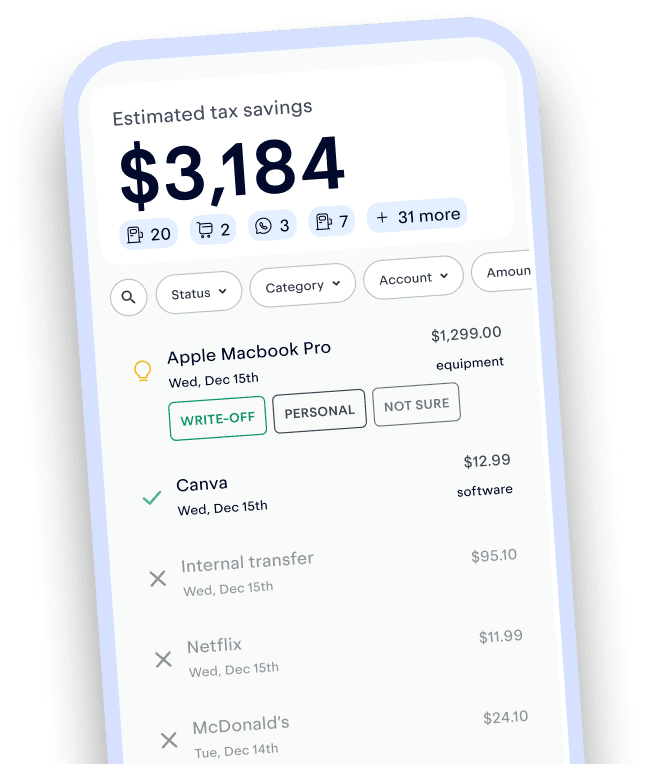
Track and claim every eligible deduction with Keeper
Keeper is the top-rated all-in-one business expense tracker, tax filing service, and personal accountant.



What tax write-offs can I claim?

What tax write-offs can I claim?
Discover effortless tax savings, with Keeper Tax

File complex taxes confidently



Recommended Videos
More Articles to Read


