






If you financed a personal vehicle
This scenario is the most common one: it applies to the majority of freelancers and small business owners.
Let's say you have a personal vehicle that you use for business-related trips at least part of the time.
If you bought this vehicle using a car loan, you won't be able to write off your car payment. However, you can write off a portion of the interest on your car loan.
That's right — your loan interest counts as a car-related business expense, just like gas and car repairs. As with all car-related expenses, the IRS gives you two possible options for writing it off: the actual expense method and the standard mileage method.
In both cases, you'll enter your total vehicle deduction — including your loan interest — on Schedule C of your tax return.
Writing off car loan interest with the actual expense method
Under the actual expense method, you can deduct all of your car expenses that were directly related to your work — including the loan interest portion of your car payments.
Let's unpack what that means. In a lot of cases, self-employed people use the same car for both personal use and business use. So for tax purposes, you can only write off a portion of your expenses, corresponding to your business use of the car.
For example, say you have a side hustle gig for which you use your personal vehicle to ferry homemade pies to customers. If 60% of your driving time is used for pie delivery and 40% is for personal tasks, you can deduct 60% of your auto loan interest.
The costs you can deduct with the actual expenses method include gas, repairs, insurance, oil changes — all your vehicle operating costs, plus your car’s depreciation.
Who should use the actual expenses method?
For most freelancers and independent contractors, writing off actual car expenses typically yields a higher deduction than taking the standard mileage rate. (One common exception is self-employed taxpayers who drive a lot for business reasons, like rideshare drivers and truckers. More on that later!)
If you choose to deduct actual vehicle expenses, you'll have to stay on top of your recordkeeping, making tedious manual logs of all trips taken in the vehicle for business purposes, plus records of the interest paid on your car loan. But with the right organizational tools, this method can be a breeze.
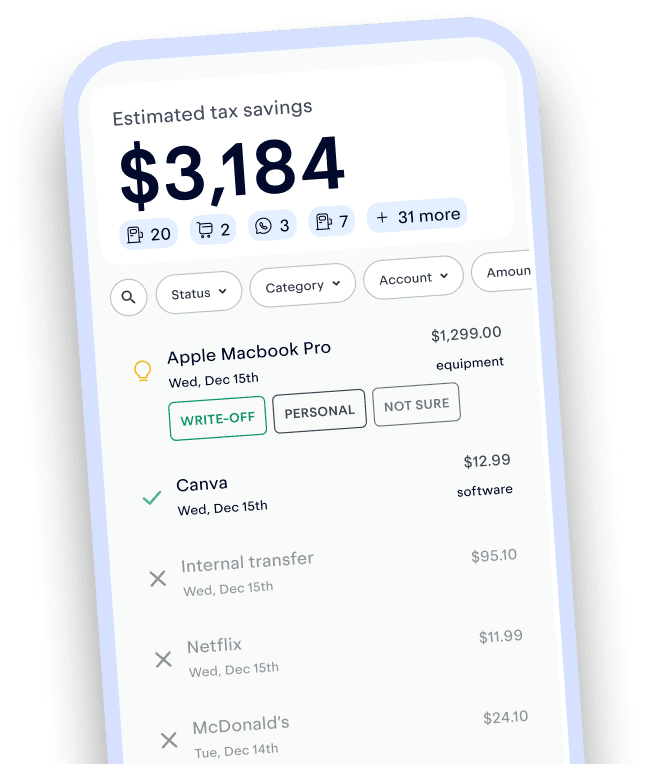
Expense tracking software can help you keep all of your car expenses organized. With Keeper, you can track all your business purchases effortlessly. That way, you won't miss out on any car write-offs come tax season.
{upsell_block}
Writing off car loan interest with the standard mileage method
If you choose to take the standard mileage deduction, you can't take any vehicle expenses as a separate write-off.
Instead, all of these write-offs are included in a standard mileage rate set by the IRS. You'll get to write off that amount for every business mile you drive.
To use this method, you'll need to keep good records for your business mileage using a mileage log. Pro tip: Commuting miles don't count. (These are the miles you drive from your home to your regular place of business, like your office or your coworking space.) For more information, check out our post on business vs. commuting miles!
Keep in mind that, with this method, there are some costs that aren't included in the standard mileage rate: parking fees, tolls, DMV fees, and even car washes. That means you'll still have to do some expense tracking, using Keeper or a manual expense-organizing system.
Here's an example of how the standard mileage rate method works. Pretend I'm a self-employed personal shopper who has to visit clients for styling appointments.
For all these client visits, I racked up 5,000 miles in a year. To calculate my write-off, I take 5,000 and multiply it by the IRS standard mileage rate. Let's say that mileage rate is $0.56 for the year in question. That yields a tax deduction of $2,800. (For 2024, that rate is $0.67 - 67 cents per mile)
Who should use the standard mileage method?
In general, the standard mileage rate is the best method for writing off car expenses if you do a whole lot of driving for work. If you're a more typical freelancer — and especially if you work out of a home office — taking actual expenses is likely to save you more on your tax bill.
To learn more about the difference between these two methods, you can check out our detailed breakdown of the standard mileage method vs. actual expenses.
{email_capture}
If you financed a work vehicle through your business
What if your small business owns your vehicle? Maybe you do all your freelancing through an LLC, and the loan is in your business’s name.
In that case, the monthly payments will likely be paid directly from your business's bank account.
If this is true for you, then odds are good that your vehicle is used 100% for business purposes. You're not likely to be grocery shopping or dropping your kids off in the company car, after all.
Assuming your business-owned vehicle is used exclusively for work, you can write off 100% of what you're paying in interest on your car loan. Just use the actual expenses method described above.
{write_off_block}
If you leased a vehicle
Now, say your monthly car payment isn't for an auto loan — it's for a lease.
In that case, you can use the actual expense method to deduct the business portion of your lease payments.
For example, if I use my car for business 60% of the time and my lease payment is $500, I can claim $300 per month as a write-off.
Over 1M Americans trust Keeper for their complex taxes
Keeper is the #1 tax app for freelancers and businesses-of-one. Capture every deduction, credit, and tax-saving opportunity with expert review on every return.



Sign up for Tax University
Get the tax info they should have taught us in school
Track and claim every eligible deduction with Keeper
Keeper is the top-rated all-in-one business expense tracker, tax filing service, and personal accountant.



What tax write-offs can I claim?

What tax write-offs can I claim?
Discover effortless tax savings, with Keeper Tax
File complex taxes confidently



Recommended Videos
More Articles to Read


