




.png)



What is a tax write-off?
A tax write-off, also called a deduction, is a business-related expense that self-employed workers can claim on their federal tax return. It decreases the amount of income you’ll be taxed on.
Let’s say that in a year, you make a total of $5,000 from your blog, where you review dog toys. Chances are, you won’t get to enjoy the entire $5,000 — after all, you spent money to:
- 🌐 Own your domain name
- 🦴 Purchase toys to review
- 📽️ Film B-roll
…and so on.
You can write off these expenses, which means you’ll subtract them from that $5,000 in income. Your taxable income is the amount that’s left. So if your tax-deductible expenses total $400, you’ll only pay taxes on $4,600.
Can you write off products you review?
Yes, if you meet these three criteria:
- You’re a self-employed product reviewer
- Your operation is a business, not a hobby
- You’re using the products exclusively for review purposes
1. You’re a self-employed product reviewer
If you’re a W-2 employee working for an employer, you won’t be able to deduct any related expenses, including review products. (However, you might be able to get those costs reimbursed if you pay for them up front.)
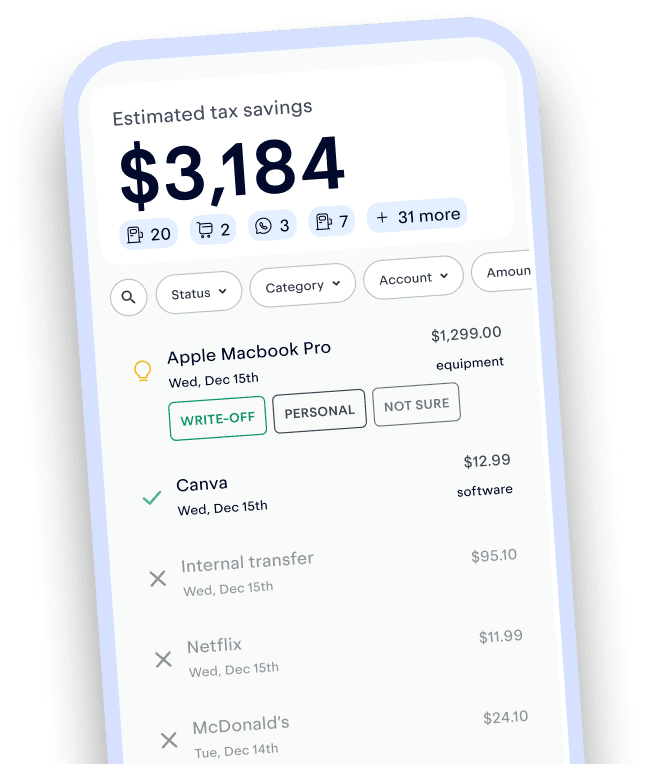
If you’re self-employed — working as a contractor, for example, or running the reviews operation yourself — you can deduct business expenses. You can track these and other tax-deductible expenses using the Keeper app, so you can maximize your savings during tax time.
2. Your operation is a business, not a hobby
Next question: In the eyes of the IRS, is your reviews operation a business or a hobby?
Hobbyists, who don’t have to pay self-employment tax, aren’t permitted to take business write-offs. If you run a bona fide business, though, you’ll have to pay self-employment tax — but you can take business write-offs to make up for it.
If this all seems a little nebulous, don’t worry. If you’re publishing reviews in order to turn a profit, it most likely counts as a business. This is true even if you’re not quite profitable just yet, as long as you’re putting in serious effort.
Still not sure if your review operation counts? The IRS has a list of nine things to consider when deciding whether you’ve got a hobby or a business on your hands.
{upsell_block}
3. You’re using the product exclusively for review purposes
Decided you have a business? Sweet. The key thing to consider, according to New York-based CPA Paul Miller, is “whether these products are used exclusively for review purposes or have a dual purpose.”
For instance, if you’re a streamer who reviews video games on Twitch, you can write off the games you review as long as you use them exclusively for streaming on your channel. If you play the game for recreational purposes, it’s best to either get a second copy or forgo the write-off entirely.
In general, the same goes for things like beauty products or makeup, which are likely to serve both personal and professional uses if you review them for work. Want to buy that new eyeshadow palette and review it on TikTok? Great — but if you also plan to use it when you go out with friends on the weekends, you shouldn’t claim it as a write-off. You could buy a second palette for personal use, sure, but the cost of doubling up might render the deduction pretty much worthless.
Can you take a partial write-off?
Potentially. In some cases, according to Miller, you may be able to “deduct a portion of the expense proportional to the business use” — that is, write off the percentage of the time you used the item for work, as opposed to personal purposes.
There’s some gray area here, so it’s best to go case by case. For example, if you purchased a six-pack of snacks and ate all of them on camera, go ahead and write off the full cost: You consumed the entire product while you were filming the review. If you ate half the snacks for your review and saved the rest to eat while you’re watching TV later, write off half the cost.
A sweater, on the other hand, is a different story — not only is it not explicitly consumable, it’s also quite difficult to write off clothing that could be worn in non-work scenarios. (Case in point: The 1980 court case Pevsner v. Commissioner, in which the court ruled that a manager at an Yves Saint Laurent boutique could not write off the YSL clothes she was required to purchase and wear for work. The reason? Even though she didn’t wear the clothes on her personal time, she theoretically could — and the possibility was enough for them to disallow the write-off.)
How to write off review products as a business expense
In the clear and ready to take the deduction? Here’s how it works.
You’ll report your income and business write-offs using Form Schedule C. Write off review products using Line 27a: “Other expenses.”
{write_off_block}
Other expenses reviewers can deduct
Besides the review products themselves, there are other business expenses you might be able to deduct as well. To determine which apply to you, ask yourself: What do I need to do my work successfully? The list you come up with is likely your list of write-offs.
Here are a few examples:
- 🌐 Wi-Fi: If you use your internet connection for work purposes, that’s a write-off! You’ll just need to calculate your business-use percentage
- 💻 Computer: Same goes for your laptop or desktop computer — you can deduct the percentage you use for work
- 📱 Phone: Plenty of phone-related expenses (including your cell phone bill!) can be deductible, too, if you use your phone frequently for work purposes
- 📹 Video equipment: If you release content in video form, the equipment you use to film is a tax deduction— think ring lights, backdrops, and props
- 🏡 Web hosting: Need a website for your business? You can write off the cost of your domain name and hosting
When your write-offs are squared away and you’re ready to file, you can do so right on the Keeper app, with a team of tax assistants available to help you through the process. Not to be too thirsty, but maybe you’ll even leave it a good review.

Over 1M Americans trust Keeper for their complex taxes
Keeper is the #1 tax app for freelancers and businesses-of-one. Capture every deduction, credit, and tax-saving opportunity with expert review on every return.



Sign up for Tax University
Get the tax info they should have taught us in school
Track and claim every eligible deduction with Keeper
Keeper is the top-rated all-in-one business expense tracker, tax filing service, and personal accountant.



What tax write-offs can I claim?

What tax write-offs can I claim?
Discover effortless tax savings, with Keeper Tax

File complex taxes confidently



Recommended Videos
More Articles to Read


