







The very first thing that might sound trippy is that the IRS doesn't treat your LLC as a business separate from you. By default, the IRS classifies a single-member LLC as a disregarded entity, which means your business income = your personal income. A multi-member LLC is treated as a partnership by default. Neither structure allows you to put yourself on a traditional payroll the way a corporate W-2 employee would be.
This means that unless you've made a special tax election, you cannot pay yourself a W-2 salary from a default LLC. Instead, you use a method called an owner's draw.
Method #1: Owner's draw
An owner's draw is exactly what it sounds like: you withdraw money from your business profits for personal use. You can do this by writing yourself a business check, transferring funds from your LLC's bank account to your personal account, or even paying a personal expense directly from the business account.
Single-member LLCs and multi-member LLCs taxed as partnerships typically use this method.
3 steps to pay yourself using owner's draw:
- Transfer money from your LLC account to your personal account as needed
- Label these transfers clearly in your accounting software as "Owner's Draw"
- No payroll taxes are withheld at the time of the draw
Keeper pro tip: Just because no taxes are withheld doesn't mean no taxes are owed! The IRS taxes you on all your LLC's profits, not just what you draw out. If your LLC earns $90,000 and you only draw $50,000, you still owe income tax (and self-employment tax) on the full $90,000. This is why quarterly estimated tax payments are important. The IRS requires you to pay estimated taxes 4 times per year if you expect to owe $1,000 or more in federal taxes. You can use Keeper's free quarterly tax calculator to estimate your payments, and pay them online with the IRS's free EFTPS system.
Our best advice to you is to be proactive. Set aside 25–30% of every owner's draw for taxes. For those with higher incomes or who reside in higher-tax states, 30–35% may be more appropriate.
If you've missed a payment, you may owe underpayment penalties. You can use our free estimated tax penalty calculator to estimate your underpayment penalties. Don't fret! A missed payment isn't the end of the world, use our missed quarterly payment guide to get all caught up.
Method #2: Guaranteed payments
If you have business partners in your LLC (that is, you have a multi-member LLC), there's a second option alongside profit distributions: guaranteed payments. A guaranteed payment is a fixed amount paid to a member regardless of whether the business is profitable - basically, a salary equivalent. These payments are typically outlined in your LLC's operating agreement and are deductible as a business expense.
A word or warning: Guaranteed payments are still reported on your personal tax return and are subject to self-employment tax!
Method #3: W-2 salary + distributions (LLC taxed as an S-Corp)
If you're making more than $60-80K in net profit from your business, it might be time to look into electing as an S-Corp for the tax savings! This doesn't change your LLC's legal structure. You're still an LLC with the same liability protections. But the IRS now treats your income differently, and that difference can translate into significant tax savings.
As a default LLC owner, you pay 15.3% self-employment tax (covering Social Security at 12.4% and Medicare at 2.9%) on your entire net profit. With an S-Corp, only the salary portion you pay yourself is subject to those payroll taxes. Profit distributions above your salary are taxed as regular income (but aren't subject to self-employment tax).
Imagine your LLC nets $120,000 in 2026. As a default single-member LLC, you'd owe self-employment tax on the full amount. With an S-Corp election, you pay yourself a reasonable salary of $70,000. That $70,000 is subject to payroll taxes, but the remaining $50,000 is taken as a distribution, and those distributions avoid the 15.3% self-employment tax. That's roughly $7,650 in tax savings.
Keeper has a free S-Corp tax savings calculator you can use to estimate how much an S-Corp could save you in taxes.
Generally, an S-Corp makes sense if:
- Your LLC nets more than $60-80K per year consistently
- You actively work in the business
- You can absorb the additional administrative costs of running payroll
If you're considering electing S-Corp status, check out our complete guide here.
{upsell_block}
Quick reference guide on how to pay yourself as an LLC
The QBI deduction can change things
If your LLC qualifies for the Qualified Business Income (QBI) deduction under Section 199A, which allows eligible self-employed individuals to deduct up to 20% of their qualified business income, there's a delicate balancing act with S-Corp salary decisions.
Under an S-Corp, the salary you pay yourself reduces your net business income, which in turn reduces your QBI deduction. If you pay yourself a higher salary to look compliant for reasonable compensation purposes, you shrink the business income eligible for the 20% deduction.
This trade-off is one reason why simply electing S-Corp status for the tax savings is incomplete without a full tax projection. It's best to have a CPA model both scenarios and estimate the best outcome for you. Need help? Your first consultation is free with a Keeper CPA.
Disclaimer: This article is for informational purposes only and does not constitute tax, legal, or financial advice. Tax laws can change, and individual circumstances vary. Consult a qualified CPA or tax attorney for advice specific to your situation.

Over 1M Americans trust Keeper for their complex taxes
Keeper is the #1 tax app for freelancers and businesses-of-one. Capture every deduction, credit, and tax-saving opportunity with expert review on every return.



Sign up for Tax University
Get the tax info they should have taught us in school
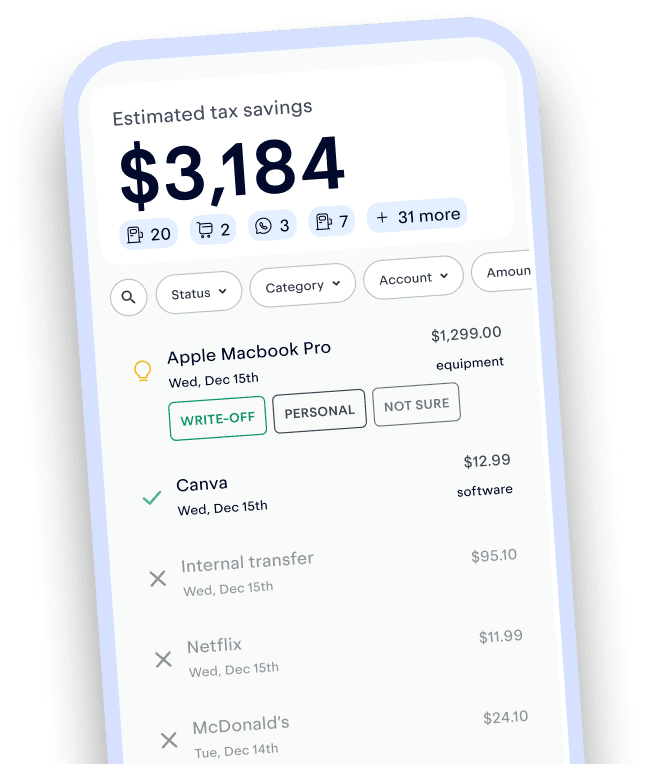
Track and claim every eligible deduction with Keeper
Keeper is the top-rated all-in-one business expense tracker, tax filing service, and personal accountant.



What tax write-offs can I claim?

What tax write-offs can I claim?
Discover effortless tax savings, with Keeper Tax

File complex taxes confidently



Recommended Videos
More Articles to Read


