




Businesses can deduct 100% of their restaurant meals for 2021 and 2022
Prior to the enactment of the CAA, the U.S. Tax Code only allowed a business to deduct 50% of its expenses for meals, whether or not they were provided by a restaurant. The 50% deduction still applies for business meals that are not provided by a restaurant. After 2022 the restaurant deduction will return to 50% of the cost of business meals. Meals while traveling count for this tax deduction as well.
Under the CAA, businesses can deduct 100% of business meals provided by restaurants, including meals taken during business travel and meals offered to employees for the convenience of the employer. Unfortunately, the Internal Revenue Code does not define the term “restaurant,” but many experts believe the deduction would apply to food delivered by restaurants.
The deduction for those meals had been set at 50% prior to the CAA under the assumption that the business owner or employee would have been eating a meal, regardless of whether it was for business purposes. In other words, Congress did not want to give a full deduction for a meal that you would have eaten anyway.
Which meals qualify as travel-related?
If you are an independent contractor or freelancer and plan to take a meal deduction as part of your travel expenses you will first need to show that the trip was taken in connection or pursuit of an existing business such s business meetings. Travel expenses that you incur while you are starting or buying a new business are not deductible but may be considered deductible startup expenses. We recommend you use our travel expenses tracker for all of your other business travel expenses.
Once you have established that the trip was for business purposes you must then show that you really were away from home. The IRS usually makes that determination based on whether you have traveled away from the general area or vicinity of the “tax home” of your principal place of business.
{write_off_block}
The impact of the Tax Cuts and Jobs Act
One of the ways that the 2017 tax law, Tax Cuts and Jobs Act (TCJA), was able to offset the revenue losses from reducing the tax rate on corporations and other businesses was by eliminating some common deductions, including the deduction for business entertainment. Like meal expenses, entertainment expenses had been 50% deductible.
In a notice issued after the enactment of the TCJA the IRS said that business meals cannot include “entertainment activities” and that meals taken during such activities needed to be accounted for separately The IRS also specified that the following expenses were no longer deductible as business entertainment expenses:
- Country clubs
- Golf and athletic clubs
- Sporting events
- Hunting or fishing trips
- Theaters
- Night clubs
- Cocktail lounges
The IRS has clearly stated that the changes to the business entertainment exemption did not impact the deductibility of business meals. However, the service added that office snacks provided to on-premises employees are no longer deductible, despite having been deductible prior to the enactment of the TCJA.
Additionally, the IRS has said that any on-site meals an employer supplies for the employer’s convenience are no longer exempt. For example, if a company orders pizza for employees who are working late so that they can continue working on a project, that cost is not deductible. Employers had been able to deduct 100% of the cost of those meals.
{email_capture}
What qualifies as a “business meal”?
The IRS has yet to issue guidance on the temporary 100% deduction for restaurant meals, but it had adopted a five-part test to determine whether you can deduct 50% of a business meal as a deduction:
- The business expense must be “ordinary and necessary”
- The business owner, or an employee, must be present for the meal
- The expense can’t be lavish or extravagant, given the circumstances
- The food and beverages were provided to a current or potential customer, client, consultant, or similar business contact.
- If the food and beverages were part of a nondeductible entertainment activity, you must have purchased them separately.
When the food and beverages are offered as part of the nondeductible entertainment event the costs must be reasonable. That provision is intended to prevent businesses from inflating food and beverage expenses to cover the cost of the entertainment. Also, if the meal is lavish and extravagant, you will not be allowed a deduction for the portion of the meal found to be lavish and extravagant.
The per-diem amounts an employer provides to reimburse employees meals is only 50% deductible. But if you provide per-diem reimbursement for an independent contractor, any amounts you pay them will be reported taxable compensation on their Form 1099s. As a result, those per-diem payments will be fully deductible because they are accounted for as contract services and not meals.
{upsell_block}
What meals are 100% deductible?
Some types of meals were 100% deductible prior to the enactment of the CAA and remain so. For example, you can claim a 100% deduction when a client reimburses you for a meal. The 100% deduction also applies in the following situations:
- The meal is purchased for a social or recreational event that was not for the convenience of the employer, like a company picnic or holiday party
- The food is provided to the public for free as part of a promotional or advertising campaign
- The cost of a meal is included in an employee’s Form W-2 compensation
- Meals or other food are provided as part of a charitable sporting event
- Businesses that sell food can deduct 100% of free meals it provides to employees when they are not on the clock
How do I claim the deduction for meals?
If you are a freelancer or independent contractor who has received payments that were reported on a Form 1099 you will claim your deduction for meals on your Form 1040 Schedule C.
To calculate the amount you can deduct you need to first total up all of your meals expenses for the year that were incurred while either traveling and entertaining clients. You then divide those that are 50% deductible in half and add them to the expenses that are 100% deductible. You will enter your total deduction on line 24b, Deductible Meals. If you have any questions, contact a CPA or accountant.
Over 1M Americans trust Keeper for their complex taxes
Keeper is the #1 tax app for freelancers and businesses-of-one. Capture every deduction, credit, and tax-saving opportunity with expert review on every return.



Sign up for Tax University
Get the tax info they should have taught us in school
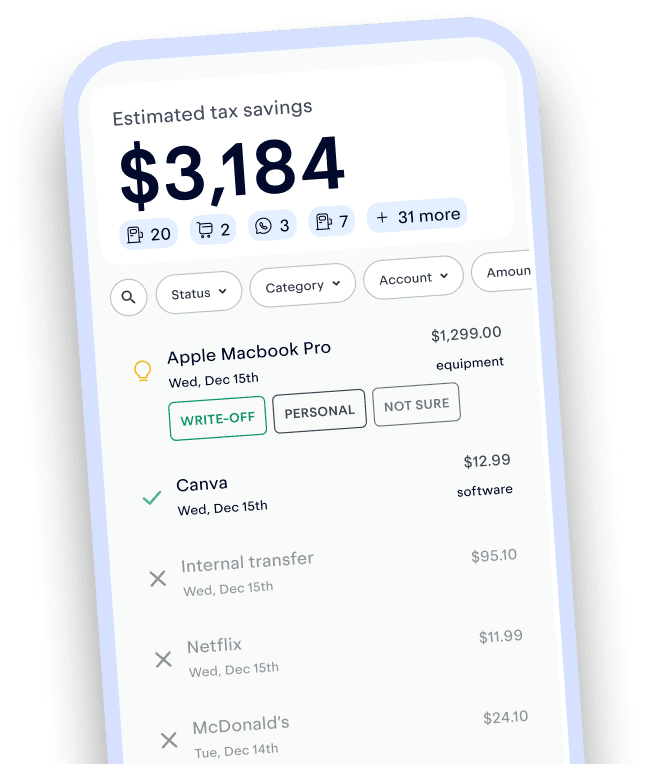
Track and claim every eligible deduction with Keeper
Keeper is the top-rated all-in-one business expense tracker, tax filing service, and personal accountant.



What tax write-offs can I claim?

What tax write-offs can I claim?
Discover effortless tax savings, with Keeper Tax

File complex taxes confidently



Recommended Videos
More Articles to Read


