







Who can write off clothes on their taxes?
If you're a sole proprietor or small business owner, you might be able to write off your work clothes — not to mention other clothing-related expenses.
That's right: the IRS allows for certain items of clothing to be written off as business expenses, depending on how they're used. Eligible pieces of clothing can be claimed alongside your other deductible expenses, on Schedule C of your tax return.
You have to be self-employed to write off your work clothes. If you're a regular W-2 employee, you'll either have to swallow the cost of any uniforms, or have your employer reimburse you for it.
Rules for writing off clothes
Any clothes you're trying to claim as a business deduction have to be "ordinary and necessary" expenses.
That means it's normal for taxpayers in your line of work to claim them, and they're necessary for you to do your job. (If you're a writer who works from home, for example, chances are you won't be able to deduct any clothing.)
In practice, your clothes will have to meet two specific requirements in order to qualify as a write-off: 1) You have to wear it for work, and 2) You can only wear it for work.
1. You have to wear it for work
This rule was written with uniforms in mind. But it includes other items that are necessary and practical to complete your work.
One obvious example would be protective clothing for a job like construction. Your hard hat, work gloves, safety glasses, and safety boots would all be tax-deductible.
Other possibilities include:
- Wearing a bandana and T-shirt to get a dogwalking bonus from Wag
- Buying a crazy hat for an acting audition,
- Investing in a historical getup for a Renaissance-themed Patreon skit.
Bottom line: You can write it off if you have to wear it to get paid.
2. You can only wear it for work
For your work clothes to qualify as a tax deduction, they have to be actively unsuitable for everyday wear.
Think “scrubs” here. Sure, they look comfy. But a doctor or nurse isn’t going to wear their scrubs on a night out.
Work clothes that aren’t deductible
This second rule can make it pretty hard to claim clothing write-offs. For example, say you're an independent contractor for a company that requires you to wear a plain black T-shirt and khakis on the job.
The outfit may be non-negotiable if you want to get paid, but you still can't claim it as a write-off. Why? Because you can wear it when you’re off the clock without getting any weird looks (or having strangers ask you medical questions at dinner).
From the IRS's point of view, other, more distinctive outfits still fail to meet this requirement.
Say you're in a field like real estate, where you have to look polished and professional in front of clients. You still can't deduct your business attire, like your suits and ties. And if you're a painter, you can't write off the overalls you use to protect your regular clothes.

These two rules are intentionally limiting so that people don’t go nuts and try to write off their shopping sprees. (Believe me, there have been some tax court cases over this).
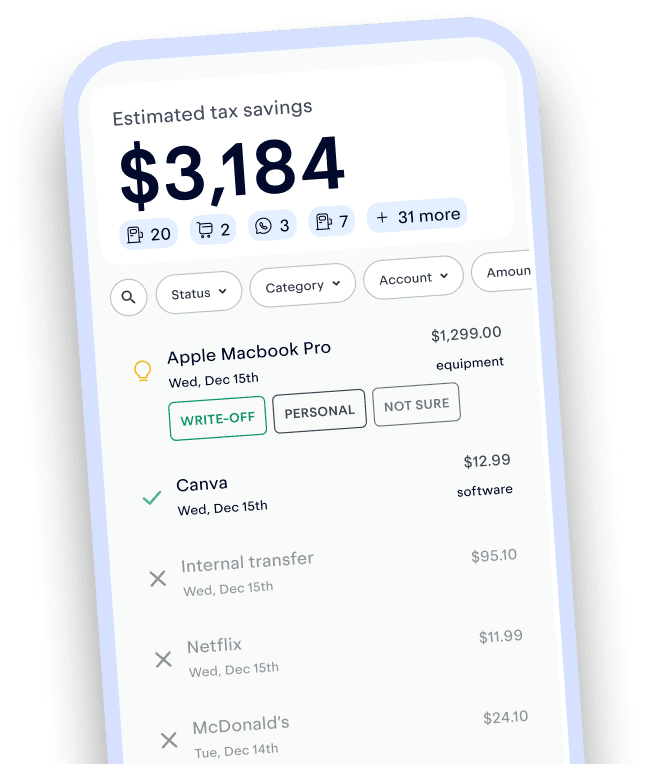
But if you do find yourself buying deductible work clothes, keeping track of your write-offs doesn't have to be hard — you don't even need to hoard a bunch of receipts. Keeper's deductions tracker automatically monitors your purchases for common work uniform outlets, like Aramark, and makes sure you get the tax write-offs you deserve.
{upsell_block}
Deducting rented clothing
What if you rent your work clothes instead of buying them?
Good news: Rented clothing may qualify as a tax deduction if it means the requirements above. For example, say you rent some safety gear for a gig, or a distinctive costume for a promotional photoshoot.
If you bought the clothes, they'd be tax-deductible. So the same principle applies for a rental.
Deducting clothes as a promotional expenses
There's one exception to the rule that deductible clothes can't be worn outside of work. That's what we might call "promotional clothing" — clothes that feature your business logo.
If you wear promotional clothing to a trade show, or for a photoshoot, then they essentially count as an advertising expense. That means you can deduct both the cost of the clothing itself and the cost of getting it printed or embroidered with your company logo.
{email_capture}
Deducting laundry expenses
If your clothes do qualify as business expenses, you can also write off the cost of upkeep. That means dry cleaning expenses and fees for alterations — even shoe polishes.
Just make sure your maintenance expenses meet the IRS standards for ordinary and necessary. In this context, that means not trying to dry clean anything that's machine-washable.
Claiming laundry charges as a business travel expense
If you go on an extended business trip, you might find yourself away from your trusty washing machine or laundromat, with no choice but to pay for expensive hotel laundry service.
Luckily, those laundry fees count as a legitimate business expense, and you can deduct them on your taxes. That's true even if you're washing clothes suitable for everyday use, even though they normally wouldn't qualify as a business expense.
Think of it this way: traveling was necessary for your work. And you wouldn't have spent that extra laundry money if it weren’t for your trip.
Just make sure you don't spring for dry cleaning unless your clothes actually require it.
{write_off_block}
Deducting makeup and personal care
If you're a freelancer or business owner who sometimes has to invest in your appearance for work purposes, odds are good that your spending doesn't stop with clothes. What about makeup and other forms of personal care, like haircuts?
Just like with clothes, makeup and other personal appearance deductions have to be used exclusively for work to count. If you're a musician or entertainer, for example, you can only write off makeup that you’d never wear on your personal time.
The one possible exception is for professional makeup artists. If you're a MUA, the cosmetics you use are tax-deductible, because you need them for your day-to-day business operations.

Over 1M Americans trust Keeper for their complex taxes
Keeper is the #1 tax app for freelancers and businesses-of-one. Capture every deduction, credit, and tax-saving opportunity with expert review on every return.



Sign up for Tax University
Get the tax info they should have taught us in school
Track and claim every eligible deduction with Keeper
Keeper is the top-rated all-in-one business expense tracker, tax filing service, and personal accountant.



What tax write-offs can I claim?

What tax write-offs can I claim?
Discover effortless tax savings, with Keeper Tax

File complex taxes confidently



Recommended Videos
More Articles to Read


